History of North America
Geologic history

Principal hydrological divides of North America.
Laurentia is an ancient craton which forms the geologic core of North America; it formed between 1.5 and 1.0 billion years ago during the Proterozoic eon.[37] The Canadian Shield is the largest exposure of this craton. From the Late Paleozoic to Early Mesozoic eras, North America was joined with the other modern-day continents as part of the supercontinent Pangaea, with Eurasia to its east. One of the results of the formation of Pangaea was the Appalachian Mountains, which formed some 480 million years ago, making it among the oldest mountain ranges in the world. When Pangaea began to rift around 200 million years ago, North America became part of Laurasia, before it separated from Eurasia as its own continent during the mid-Cretaceous period.[38] The Rockies and other western mountain ranges began forming around this time from a period of mountain building called the Laramide orogeny, between 80 and 55 million years ago. The formation of the Isthmus of Panama that connected the continent to South America arguably occurred approximately 12 to 15 million years ago,[39] and the Great Lakes (as well as many other northern freshwater lakes and rivers) were carved by receding glaciers about 10,000 years ago.
North America is the source of much of what humanity knows about geologic time periods.[40] The geographic area that would later become the United States has been the source of more varieties of dinosaurs than any other modern country.[40] According to paleontologist Peter Dodson, this is primarily due to stratigraphy, climate and geography, human resources, and history.[40] Much of the Mesozoic Era is represented by exposed outcrops in the many arid regions of the continent.[40] The most significant Late Jurassic dinosaur-bearing fossil deposit in North America is the Morrison Formation of the western United States.[41]
Pre-Columbian

The El Castillo pyramid, at Chichén Itzá, Mexico.
The indigenous peoples of North America have many creation myths by which they assert that they have been present on the land since its creation.[42] The specifics of Paleo-Indian migration to and throughout the Americas, including the exact dates and routes traveled, are subject to ongoing research and discussion.[43] The traditional theory has been that these early migrants moved into the Beringia land bridge between eastern Siberia and present-day Alaska around 25,000 to 11,000 years ago.[44] The few agreements achieved to date are the origin from Central Asia, with widespread habitation of the Americas during the end of the last glacial period, or more specifically what is known as the late glacial maximum, around 13,000 years before present.[45] Some genetic research indicated secondary waves of migration occurred after the initial Paleo-Indian colonization,[46] but prior to modern Inuit, Inupiat and Yupik expansions.[47]
Before contact with Europeans, the natives of North America were divided into many different polities, from small bands of a few families to large empires. They lived in several "culture areas", which roughly correspond to geographic and biological zones and give a good indication of the main lifeway or occupation of the people who lived there (e.g., the bison hunters of the Great Plains, or the farmers of Mesoamerica). Native groups can also be classified by their language family (e.g., Athapascan or Uto-Aztecan). Peoples with similar languages did not always share the same material culture, nor were they always allies. Anthropologists think that the Inuit people of the high Arctic came to North America much later than other native groups, as evidenced by the disappearance of Dorset culture artifacts from the archaeological record, and their replacement by the Thule people.
During the thousands of years of native habitation on the continent, cultures changed and shifted. One of the oldest cultures yet found is the Clovis culture of modern New Mexico. Later cultures include the Mississippian culture and related Mound building cultures, found in the Mississippi river valley and the Pueblo culture of what is now the Four Corners. The more southern cultural groups of North America were responsible for the domestication of many common crops now used around the world, such as tomatoes and squash. Perhaps most importantly they domesticated one of the world's major staples, maize (corn).
The earliest verifiable instance of pre-Columbian trans-oceanic contact by any European culture with the landmasses that geologically constitute the "mainland" of modern North America has been dated to the end of the 10th century CE - this site, situated at the northernmost extent of the island named Newfoundland, is known as L'Anse aux Meadows, where unmistakable evidence of Norse settlement was uncovered in the early 1960s.[48]
As a result of the development of agriculture in the south, many important cultural advances were made there. For example, the Maya civilization developed a writing system, built huge pyramids and temples, had a complex calendar, and developed the concept of zero around 400 CE, a few hundred years after the Mesopotamians.[49] The Mayan culture was still present in southern Mexico and Guatemala when the Spanish explorers arrived, but political dominance in the area had shifted to the Aztec Empire whose capital city Tenochtitlan was located further north in the Valley of Mexico. The Aztecs were conquered in 1521 by Hernán Cortés.[50]
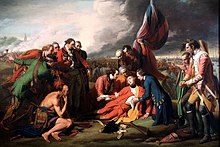


Benjamin West's The Death of General Wolfe (1771) depicting the Battle of the Plains of Abraham.
Colonial period
Main article: European colonization of the Americas
Further information: Timeline of the European colonization of North America, British America, French America, Viceroyalty of New Spain, and Russian colonization of the Americas
During the Age of Discovery, Europeans explored and staked claims to various parts of North America. Upon their arrival in the "New World", the Native American population declined substantially, because of violent conflicts with the invaders and the introduction of European diseases to which the Native Americans lacked immunity.[51]Native culture changed drastically and their affiliation with political and cultural groups also changed. Several linguistic groups died out, and others changed quite quickly. The names and cultures that Europeans recorded were not necessarily the same as the names they had used a few generations before, or the ones in use today.
Britain, Spain, and France took over extensive territories in North America - and fought over them. In the late 18th century and beginning of the 19th, independence movements that sprung up across the continent, led to the creation of the modern countries in the area. The 13 British colonies on the North Atlantic coast declared independence in 1776, becoming the United States of America. Canada was formed from the unification of northern territories controlled by Britain and France. New Spain, a territory that stretched from modern-day southern US to Central America, declared independence in 1810, becoming the First Mexican Empire. In 1823 the former Captaincy General of Guatemala, then part of the Mexican Empire, became the first independent state in Central America, officially changing its name to the United Provinces of Central America.
Post a Comment